
Time pressures during doctor-patient consultations: why complaining doesn’t help – and which strategies to use instead

Many guides on medical consultations provide specific tips: ask questions, take notes and remain active. These things are important – but often fail to get to the crux of the issue. This is due to an inconvenient truth that is rarely openly addressed: medical consultations do not take place under ideal conditions.
Understanding why communication is difficult during everyday medical life enables us to use it in a more targeted manner – and get more out of it.
Medical consultations differ from normal conversations
At first glance, a medical consultation may appear to be an eye-level conversation, but in reality, it is a highly condensed experience:
- Limited time
- Complex information
- Great responsibility
- Emotional strain
Studies show that consultations in Switzerland last an average of 15 minutes. That is not long if you consider that diagnoses, decisions and explanations all have to take place within this period. 1)
This means that doctors have to prioritise, structure consultations – and sometimes even cut things short.
Where typical communication problems arise
Doctors are human. They are part of a medical system that often places them under time and performance pressures. This results in many potential pitfalls when it comes to communication:
Premature interruptions due to time pressures
Patients are often interrupted by doctors in less than a minute due to the medical professionals wanting to manage consultations more efficiently. 2)
The framework for complex information is often missin
Medical information is often complex and difficult to understand. Despite this, time pressures can result in consultations having to be interrupted or cut short. In such cases, information can sometimes be lost. At best, only the key information was provided but there was no scope for patient questions.
Focus on medicine, not emotionsWhen there is little time left, the focus shifts to measurable facts, with personal concerns often relegated to the background.
👉Important: these situations are rarely due to error; they are ways of adapting to a demanding and complex system.
Resultant risks for patients
If these dynamics are not identified, typical problems arise:
- Key information is not discussed
- Patients only partly understand diagnoses or treatment methods
- Misunderstandings go unnoticed
- Treatment paths are followed incorrectly or incompletely
Communication problems are an important factor with regard to the risks associated with patient care. 3)
At the same time, studies have also shown that people who do not fully understand all information are far less likely to correctly follow treatment plans. 4)
When time pressures exist, the focus shifts to measurable facts, with personal concerns relegated to the background.
Why playing the blame game does not help
It would be easy to say that doctors should simply improve the way they communicate.
But that does not get to the crux of the issue. After all, there are many influencing factors aside from the consultation itself:
- Tight schedules for appointments
- High administrative load
- Economic conditions
- Historically developed role expectations
As a result, even good communication hits structural limits during everyday medical care.
A key change of perspective for patients
Instead of regarding medical consultations as a ‘service’ to be optimally delivered, it helps to take a different view:
Consultations are a scarce resource. The aim is not to demand more, but to make better use of the time available.
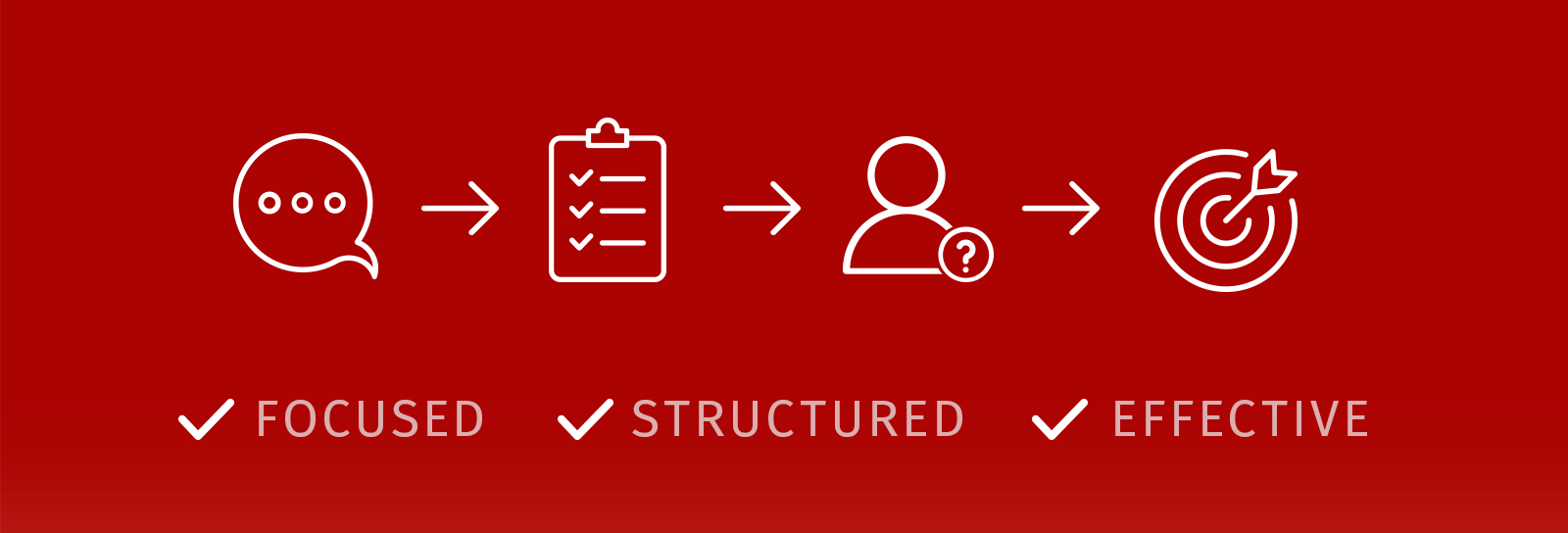
People who understand this can approach them differently:
Actively instead of passively
Clearly instead of vaguely
In a structured manner instead of spontaneously
How EverAsk supports you
This is precisely where EverAsk comes in. The application has been developed to offer patients guidance when dealing with the challenging situation of consultations.
EverAsk helps patients:
- structure the things that are important to them in advance
- not forget important questions
- retain a clear picture during consultations
- process information better after appointments
With medical consultations often subject to time pressures, this structure helps make more targeted use of the time available.
Conclusion: good consultations require an understanding of reality
A medical consultation is not a perfect conversation – but a discussion under real conditions.
People who understand these conditions are able to:
- better assess typical communication problems
- detect misunderstandings at an early stage
- ask more targeted questions
- make better decisions overall
Good communication does not just come from better doctors or better patients but from a better understanding of the situation.

Sources
- Irving, G., Neves, A. L., Dambha-Miller, H., et al. (2017): International variations in primary care physician consultation time: a systematic review of 67 countries. BMJ Open, 7(10), e017902. https://doi.org/10.1136/bmjopen-2017-017902
- Beckman, H. B., & Frankel, R. M. (1984): The effect of physician behavior on the collection of data. Annals of Internal Medicine, 101(5), 692–696. https://doi.org/10.7326/0003-4819-101-5-692
Ospina, N. S., Phillips, K. A., Rodriguez-Gutierrez, R., et al. (2019): Eliciting the patient’s agenda: Have we improved? Journal of General Internal Medicine, 34(7), 1327–1332. https://doi.org/10.1007/s11606-018-4540-5 - Levinson, W., Roter, D. L., Mullooly, J. P., et al. (1997): Physician–patient communication: The relationship with malpractice claims among primary care physicians and surgeons. JAMA, 277(7), 553–559. https://doi.org/10.1001/jama.1997.03540310051034
Joint Commission (o. J.): Sentinel Event Data: Root causes by event type (Auswertungen zeigen Kommunikationsprobleme als häufige Ursache schwerer Behandlungsfehler). - World Health Organization (2003): Adherence to Long-Term Therapies: Evidence for Action. https://www.who.int/publications/i/item/9241545992
Schillinger, D., Grumbach, K., Piette, J., et al. (2003): Association of health literacy with diabetes outcomes. JAMA, 288(4), 475–482. https://doi.org/10.1001/jama.288.4.475